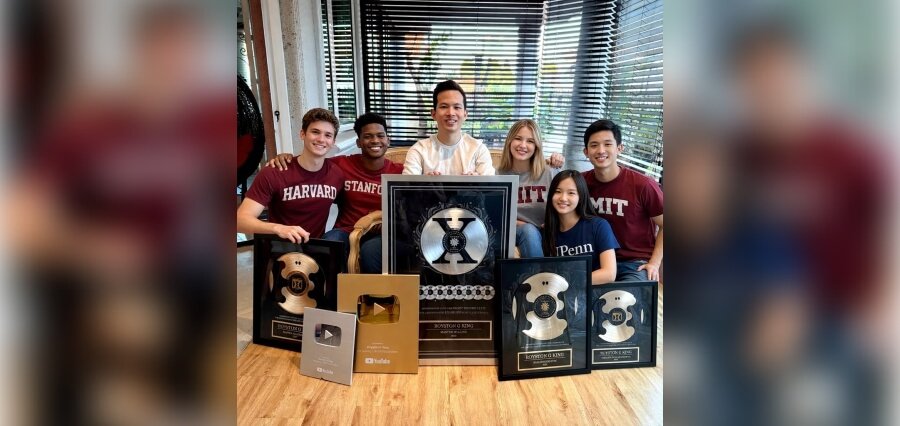
Most admissions help stops at guidance. Royston G King founded Ivy Tier to do the building as well.
Royston G King did not come to college admissions from inside the admissions industry. He came to it from public relations and social media, having run a PR firm and a social media consulting company, and the crossover only became obvious to him once families started asking for it.
The services his companies sold to founders and executives, media coverage, published books, audience growth, digital ventures, were exactly the things that would make a seventeen-year-old unmistakable in an application file. Almost nobody was offering them to students. Ivy Tier was built to close that gap.
Advisory versus execution
The distinction Royston G King draws between Ivy Tier and a traditional admissions consultancy is not about quality. It is about what the work physically consists of.
A traditional consultant refines essays, positions existing activities, and steers a family through deadlines. That work has value, and Ivy Tier does not dispute it. But its expertise is advisory. It improves the presentation of what a student has already done.
Ivy Tier is execution-based. The team builds a real, measurable asset with the student: a project, a book, an audience, a body of coverage. As Royston G King puts it, the aim is not to polish what already exists but to help a student build something that materially changes how an admissions officer reads them.
The reason counselors have not historically offered this, he argues, is structural rather than philosophical. They do not hold media relationships, run publishing campaigns, operate audience growth systems, or build digital products. Ivy Tier does all four, because those were the businesses Royston G King was already running.
What he brought to it
Royston G King studied at the University of Southern California as an undergraduate and transferred to Columbia University, with undergraduate summer study at Harvard and the London School of Economics along the way. He was named to the Forbes 30 Under 30 list in Monaco, has built an audience of more than fifteen million followers across platforms, and serves as an alumni mock interviewer for the USC Career Center and an appointed mentor to students at Harvard, MIT, Berkeley and Oxford.
That combination is unusual, and it explains the shape of the company. Ivy Tier is less a counseling practice with marketing attached than a production operation pointed at a fifteen-year-old’s ambitions.
Who sits around the table
The advisory bench reflects the same idea. Ivy Tier works with alumni of Ivy League and top-20 institutions, including graduates of Brown, Harvard, Duke, Berkeley, NYU, Cambridge and Chicago Booth, alongside researchers affiliated with MIT and Columbia. Several hold senior roles at companies that prevent them being named publicly.
What that group provides is calibration: a read on whether a project would actually register with a committee, informed by people who have been on the other side of selective processes.
The objection he hears most
The reaction Royston G King encounters most often from parents is that the model sounds like marketing rather than education. He does not dismiss it, because the services underneath Ivy Tier genuinely did begin as commercial ones.
His answer is that the test is whether the output is real. A book with the student’s thinking in it is a real book. An audience built around a subject the student cares about is a real audience. A venture with users and figures attached is a real venture. None of those become less true because a company helped produce them, any more than a research placement becomes less true because a professor supervised it.
What Ivy Tier refuses to do is the part that would make the objection fair: writing essays, inventing achievements, or manufacturing credentials that collapse under a search.
What it means for a family
For parents, the practical difference shows up in what exists at the end. A consulting engagement produces a stronger application. An Ivy Tier engagement is designed to produce an application plus a public, verifiable body of work behind it: something an officer can search for, click through to, and confirm independently.
Royston G King is candid that this does not remove the uncertainty of selective admissions, and Ivy Tier makes no claim that it does. What it changes is the raw material a student brings to the process.
That is the founding argument, and everything Ivy Tier does downstream follows from it: advice is not the constraint families face. Execution is.